
Scaling Residential Life Safety and Fire Protection: Inside Ajmera Arham, Malad
October 27, 2026
Elevating Workspaces with Professional AV and Life-Safety Solutions
October 29, 2026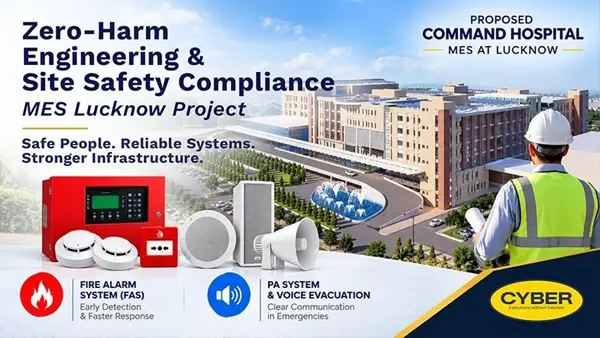
Table of Contents
1. Quick Snapshot: What is Industrial Site Safety & Compliance?
2. The High-Risk Engineering Challenge: Why Strict Safety Protocols Are Non-Negotiable
3. Inside the MES Lucknow Project: Enforcing Zero-Harm Standards on Ground
○ Mandatory Personal Protective Equipment (PPE) & Fall Protection
○ Rigorous Pre-Task Risk Assessments & Toolbag Briefings
○ Electrical, Fire, and Heavy Machinery Operational Safety
4. Why Top-Tier Contractors Refuse to Compromise on Safety Culture
5. Conclusion & FAQs
1. Quick Snapshot: What is Industrial Site Safety & Compliance?
● The Core Definition: A structured, rigorous operational framework designed to protect engineering personnel, technicians, and site workers from occupational hazards through mandatory safety protocols, continuous monitoring, and regulatory compliance.
● Key Components: Daily safety briefings, certified PPE adherence, fall arrest systems, safe electrical isolation, and emergency response drills.
● The Ultimate Advantage: Zero workplace accidents, protected human capital, heightened operational efficiency, and full alignment with strict national and institutional safety mandates.
2. The High-Risk Engineering Challenge: Why Strict Safety Protocols Are Non-Negotiable
Picture a complex, high-security infrastructure development like the MES Lucknow Project. Military engineering services and large-scale government developments require executing heavy structural installations, intricate electrical cabling, and multi-system integrations across expansive, active sites.
In such challenging environments, ignoring baseline safety guidelines or cutting corners introduces catastrophic risks—ranging from site injuries to severe project delays. Achieving a successful engineering handover requires a proactive safety culture where every worker, technician, and project manager treats “Zero Harm” as an absolute daily commandment.
3. Inside the MES Lucknow Project: Enforcing Zero-Harm Standards on Ground
At the MES Lucknow Project, Cyber Group’s operational execution is anchored by a strict, multi-tiered safety compliance methodology that governs every hour spent on-site:
● Mandatory Personal Protective Equipment (PPE) & Fall Protection: Every crew member deployed on elevated structures, risers, or confined spaces is equipped with certified full-body harnesses, high-visibility gear, industrial helmets, and specialized protective wear.
● Rigorous Pre-Task Risk Assessments & Tool bag Briefings: Before a single tool is lifted each morning, mandatory safety huddles and job-safety analyses (JSAs) are conducted to identify potential site hazards, review execution steps, and assign clear accountability.
● Electrical & Heavy Machinery Safety Protocols: Given the technical nature of fire alarm wiring, panel installations, and utility integration, strict lock-out/tag-out (LOTO) procedures are enforced to prevent electrical hazards and secure heavy equipment zones.
Engineering Note: All safety equipment, protocols, and technical execution frameworks implemented across our projects are backed by the stringent quality and supply chain standards of our parent company and distributor partner, Adit Innovations.
4. Why Top-Tier Contractors Refuse to Compromise on Safety Culture
Maintaining elite safety compliance during large-scale execution delivers foundational benefits:
● Unwavering Workforce Confidence: Workers perform at their highest potential when they know their physical well-being is heavily prioritized by management.
● Flawless Institutional Compliance: Strict adherence to defense and government safety regulations ensures seamless project clearances and milestone sign-offs.
● Elimination of Operational Downtime: Proactive hazard prevention avoids costly accidents, investigations, and site stoppages.
Conclusion
Landmark projects like the MES Lucknow Project prove that true engineering leadership is measured not only by the sophistication of the technology installed, but by the safety of the people who build it. By maintaining a rigorous, zero-harm safety culture across all nationwide operations, Cyber Group ensures that every infrastructure milestone is achieved with absolute integrity and protection.
FAQs
What does a “Zero Harm” safety policy mean in engineering execution?
It is an operational commitment to eliminating all workplace injuries, occupational illnesses, and safety incidents through proactive risk management and strict protocol enforcement.
How do daily safety toolbag briefings benefit site workers?
They keep safety awareness front-of-mind, brief workers on specific site hazards for the day, and ensure everyone understands emergency protocols before starting work.
Why is safety compliance critical for government and military projects like MES?
Institutional clients enforce rigorous statutory safety bylaws; maintaining flawless compliance is mandatory to secure project approvals, ensure worker protection, and avoid legal liabilities.