
Elevating Guest Safety: Customized ELV Solutions at Holiday Inn Gandhidham & Lemon Tree Bharuch
October 19, 2026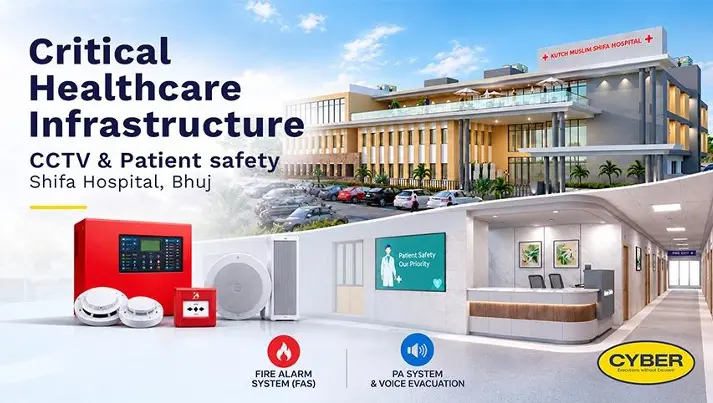
Table of Contents
1. Quick Snapshot: What is Comprehensive Healthcare Life Safety?
2. The Medical Facility Challenge: Why Hospitals Require Specialized Fire Protection
3. Inside Shifa Hospital, Bhuj: Dedicated Fire Defense & Life Safety Integration
○ Advanced Fire Alarm Systems (FAS)
○ High-Pressure Fire Hydrant Networks ○ Zoned Public Address (PA) & Emergency Evacuation
4. Why Working with a Specialized Turnkey Fire Integrator Matters
5. Conclusion & FAQs
1. Quick Snapshot: What is Comprehensive Healthcare Life Safety?
● The Core Definition: An uncompromising, synchronized life-safety architecture specifically designed to protect patients, medical staff, and sensitive diagnostic zones against fire hazards and operational emergencies.
● Key Components: Addressable fire alarm systems (FAS), zoned public address (PA) voice evacuation systems, and high-pressure fire hydrant networks.
● The Ultimate Advantage: Rapid threat detection, zero-delay emergency alerts, dependable water suppression readiness, and strict statutory compliance for medical institutions.
2. The Medical Facility Challenge: Why Hospitals Require Specialized Protection
Picture a modern medical institution like Shifa Hospital in Bhuj. Hospitals operate around the clock, housing patients with limited mobility, critical care units (ICUs), operating theaters, and high-value medical diagnostic machinery.
In a healthcare environment, standard commercial fire safety approaches are simply not enough. Evacuating individuals on life support, protecting sensitive treatment zones, and maintaining absolute system reliability requires zoned emergency communication and 24/7 readiness. Designing and executing these life-safety networks demands specialized engineering expertise.
3. Inside Shifa Hospital, Bhuj: Dedicated Fire Defense & Life Safety Integration
To deliver absolute peace of mind for medical administrators, doctors, and patients, Cyber Group executed a robust, specialized turnkey life-safety integration exclusively dedicated to fire protection at Shifa Hospital:
● Advanced Fire Alarm Systems (FAS): We deployed intelligent addressable fire alarm panels paired with ultra-sensitive smoke and heat detectors. These units provide micro-zoned threat identification, ensuring that security and nursing stations are alerted instantly at the first sign of smoke or abnormal heat.
● High-Pressure Fire Hydrant Networks: Engineered to cover all hospital blocks and service areas, robust fire hydrant systems ensure high-capacity water suppression readiness throughout the multi-story facility.
● Zoned Public Address (PA) Networks: To protect vulnerable patients, our specialized zoned PA system enables management to broadcast calm, discreet emergency voice instructions to specific hospital wings rather than triggering a disruptive facility-wide alarm.
Engineering Note: All safety components and fire protection hardware deployed across the hospital are backed by the trusted supply chain of Adit Innovations.
4. Why Working with a Specialized Turnkey Integrator Matters
Executing life safety upgrades in a functioning healthcare facility requires precision execution and deep regulatory knowledge:
● Uncompromising Patient Protection: Guarantees that life-safety networks meet strict medical licensing and national fire safety codes.
● Zero Operational Disruption: Turnkey coordination ensures installations proceed smoothly alongside sensitive hospital operations.
● Seamless System Interoperability: Ensures that fire detection alarms, water suppression lines, and emergency paging networks communicate instantly during a crisis.
Conclusion
Milestone healthcare projects like Shifa Hospital in Bhuj set a benchmark for regional medical safety. By executing rigorous Fire Alarm Systems (FAS), high-pressure Fire Hydrant installations, and zoned PA emergency networks, Cyber Group ensures that critical healthcare facilities remain completely protected, resilient, and safe for everyone who walks through their doors.
FAQs
Why are specialized Fire Alarm Systems critical in hospitals?
Addressable fire alarms offer micro-zoned, early-stage threat identification without causing widespread panic in critical care areas.
How do Fire Hydrant networks support hospital safety?
They supply high-capacity water flow across dedicated risers and valves, giving emergency responders a powerful tool to control large-scale fire hazards.
Why do hospital developers rely on experienced turnkey contractors?
Turnkey integration ensures seamless system compatibility across fire safety, adherence to strict healthcare codes, and flawless execution from initial design to final commissioning.