
Door Interlocking Systems Why Controlled Access Matters in Critical Environments
August 23, 2026
Kitchen Fire Suppression Systems Protecting Commercial Kitchens from Fire Risks
September 23, 2026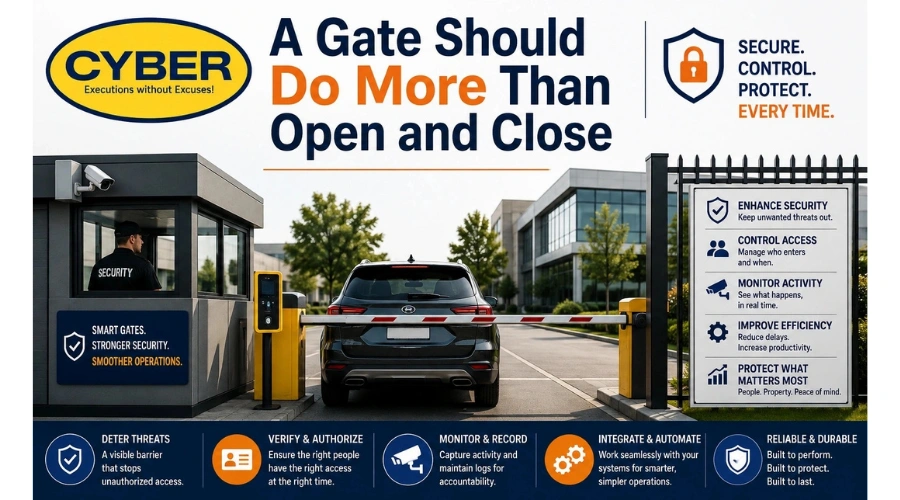
Table of Contents
- Why Facilities Are Choosing Gate Automation
- Understanding Gate Automation Solutions
- Types of Automatic Gate Systems
- Benefits Beyond Security
- Safety Features That Matter
- Integrating Gate Automation with Smart Infrastructure
- Factors to Consider Before Installation
- FAQs
Gate Automation Solutions Building Smarter Safer and More Efficient Entrances
An entrance is much more than a gateway into a property. It is where security, operational efficiency, and visitor experience come together. Whether it is an industrial facility, corporate office, residential community, educational campus, logistics centre, or healthcare institution, managing vehicle movement efficiently is essential for smooth
day to day operations.
As facilities continue to expand, vehicle traffic also increases. Employees, visitors, contractors, delivery vehicles, and emergency services all require timely and controlled access. Relying solely on manually operated gates can result in delays, inconsistent access procedures, and increased dependency on security personnel.
Gate Automation Solutions help organizations create a smarter approach to entrance management by combining automated gate operators with intelligent access technologies. The result is an entrance that supports security, improves traffic flow, and enhances operational efficiency without compromising convenience.
Why Facilities Are Choosing Gate Automation
Modern organizations require entrance systems that support both security and operational continuity.
Manual gate operation often becomes difficult during peak traffic hours when multiple vehicles arrive simultaneously. Waiting for manual verification can create congestion, increase vehicle idle time, and slow overall facility operations.
An Automatic Gate System automates these repetitive tasks by allowing authorized vehicles to enter through predefined access permissions while reducing unnecessary delays.
Besides improving efficiency, automation also provides better consistency. Every vehicle follows the same access process, reducing human error and helping organizations maintain standardized entry procedures across the facility.
Understanding Gate Automation Solutions
A Gate Automation Solution combines motorized gate mechanisms with electronic controllers, intelligent sensors, and access control technologies.
Instead of requiring manual gate operation, the system automatically opens and closes after successful authorization.
Modern Entrance Automation Systems can integrate with several authentication methods, including:
● Long range UHF RFID for touch free vehicle access
● Automatic Number Plate Recognition (ANPR)
● Mobile based credentials
● Remote controls
● PIN based keypad access
● Biometric authentication
● Vehicle loop detectors
For example, a vehicle equipped with a long range UHF RFID tag can be identified automatically while approaching the entrance. The gate opens without requiring the driver to stop or lower the window, creating a faster and more convenient access experience.
The objective extends beyond automation. It creates a structured and intelligent entrance management process that balances convenience with security.
Types of Automatic Gate Systems
Different facilities require different gate designs depending on available space, traffic volume, and operational requirements.
| Gate Type | Suitable Applications |
| Sliding Gate | Industries, warehouses, logistics centres |
| Swing Gate | Residential communities, offices |
| Cantilever Gate | Heavy duty industrial entrances and uneven ground |
| Telescopic | |
| Gate | Locations with limited side clearance |
| Folding Gate | Compact urban developments |
Selecting the right gate depends on the available installation space, expected vehicle movement, and site conditions.
Benefits Beyond Security
Although security is one of the primary reasons organizations invest in Smart Gate Automation, the benefits extend well beyond controlling access.
Automated gates improve vehicle movement by reducing waiting time at entrances. Employees can enter quickly during peak hours, while visitors and contractors can follow predefined access procedures.
Digital access records provide better visibility into vehicle movement, supporting operational reporting and audit requirements.
Touch free entry using long range UHF RFID improves user convenience while minimizing manual interaction at entry points.
Automation also reduces repetitive manual work for security personnel, allowing them to focus on monitoring and responding to security events rather than operating gates.
These operational improvements make automated gate systems suitable for both high security facilities and organizations focused on improving overall efficiency.
Safety Features That Matter
Safety should always be an essential part of every Gate Automation Solution.
Modern automated gates incorporate multiple safety mechanisms that help protect pedestrians, vehicles, and equipment during operation.
Photocell Sensors
Photocell sensors create an invisible infrared beam across the gate opening. If a vehicle or pedestrian interrupts the beam while the gate is moving, the controller immediately stops or reverses gate movement.
Safety Edge
Safety edges are installed along the moving edge of the gate. If the gate comes into contact with an object during operation, the system immediately stops to help reduce the risk of damage or injury.
Loop Detectors
Loop detectors are installed beneath the driveway surface to detect the presence of vehicles. They help prevent the gate from closing while a vehicle remains within the operating area.
Obstacle Detection and Anti Crush Protection
Modern controllers continuously monitor motor resistance. If unexpected resistance is detected because of an obstacle, the gate automatically stops or reverses direction.
Emergency Manual Release
During power failures or maintenance activities, emergency manual release mechanisms allow gates to be operated safely until normal power is restored.
Together, these features help ensure that gate automation supports both operational efficiency and user safety.
Integrating Gate Automation with Smart Infrastructure
Today’s entrance systems operate most effectively when connected with broader building technologies.
An Automatic Gate System can integrate with:
● Long range UHF RFID readers
● Automatic Number Plate Recognition systems
● CCTV surveillance
● Access control platforms
● Visitor management software
● Building Management Systems
● Security control rooms
● Centralized monitoring platforms
For example, when a registered vehicle approaches the entrance, the long range UHF RFID reader identifies the vehicle automatically. The access control system verifies authorization, the gate opens, and CCTV simultaneously records the entire event.
This coordinated workflow reduces manual intervention while improving security visibility across the facility.
Cybergroup integrates Gate Automation Solutions with surveillance, access control, visitor management, and building automation technologies, helping organizations create connected entrance management systems.
Factors to Consider Before Installation
Selecting the right Entrance Automation System involves understanding how the facility operates rather than simply selecting a gate.
Several technical considerations influence long term performance.
Gate Weight
The motor should be selected according to the weight of the gate to ensure smooth and reliable movement.
Gate Width
Wider gates require operators designed for longer travel distances and appropriate operating speeds.
Duty Cycle
Facilities with frequent vehicle movement require automation systems capable of continuous operation throughout the day.
Wind Load
Large gates exposed to high wind conditions require appropriate structural support and motor capacity.
Power Backup
Battery backup or UPS systems help maintain gate operation during power interruptions.
Traffic Volume
Vehicle frequency influences opening speed, controller selection, and automation requirements.
Installation Space
Available side clearance determines whether sliding, swing, cantilever, telescopic, or folding gates are most appropriate.
Safety Features
Photocells, loop detectors, safety edges, anti crush protection, and emergency release mechanisms should always be evaluated during system design.
Future Expansion
Organizations should consider whether additional entrances, access technologies, or centralized monitoring will be required in the future.
Planning these factors before installation helps create an automation solution that supports both current operational needs and long term scalability.
FAQs
What are Gate Automation Solutions?
They automate vehicle entry and exit using intelligent access and safety technologies.
What authentication methods can automated gates support?
Long range UHF RFID, ANPR, mobile credentials, biometric systems, keypads, and remote controls.
What safety features should an Automatic Gate System include?
Photocell sensors, safety edges, loop detectors, anti crush protection, and emergency manual release.
Can Gate Automation Solutions integrate with CCTV?
Yes. Modern systems commonly integrate with CCTV, access control, and visitor management platforms.
How do I choose the right automated gate?
Evaluate gate weight, width, traffic volume, duty cycle, available space, wind load, safety requirements, and future expansion plans.