
Fire Alarm System Installation: The Ultimate Guide
April 1, 2026
Automatic Boom Barrier Gate System: Secure & Smart Vehicle Access Control
May 1, 2026In modern buildings and industrial sites worldwide, iCAM aspirating smoke detectors (ASD) are used for ultra-early fire detection where traditional smoke sensors fall short. iCAM (by Honeywell/Gent, formerly Xtralis) offers “point-in-a-box” ASD units – essentially an entire smoke detector within a single enclosure – that actively draw air into a detector through a sampling pipe. This means the detector constantly sniffs the protected space and can sense minute smoke particles at very low concentrations. When smoke is drawn into the iCAM unit, it is filtered and analyzed by the internal sensor (for example, Gent’s S-Quad or Xtralis’s standard detectors). iCAM models (IAS or ILS series) can be mounted in place of a spot detector on a fire alarm loop, making installation straightforward. The system’s software also provides multi-level warnings: an early “smoke found” alert and a full fire alarm if smoke density rises further.
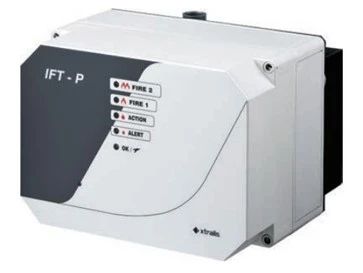
Key Features of iCAM Systems: iCAM IAS detectors are compact, wall-mounted ASD units designed for one or two sampling inlets. Key specs include: support for one or two addressable channels (IAS-1 or IAS-2 models), up to 50–100 meters of pipe per sampling inlet, and microprocessor-controlled aspirator with adjustable speed and airflow monitoring. They provide an integral status display and on-board programmer for local configuration. The iCAM housing is rated IP65 (dust-tight, water-resistant), and the unit includes a field-serviceable filter to capture dust before air reaches the sensor. iCAM detectors carry global approvals (UL/FM, EN54-20, VdS, etc.), so they meet stringent fire-safety standards for aspirating systems. Detection strategies include single or dual sensor modes, plus redundant “voting” or coincidence modes if two sensors are used.
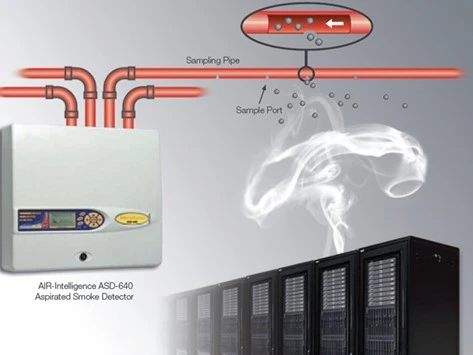
Image: iCAM IAS aspirating smoke detector drawing air from the protected area through a sampling pipe. (Filtered air is continuously monitored for smoke.)
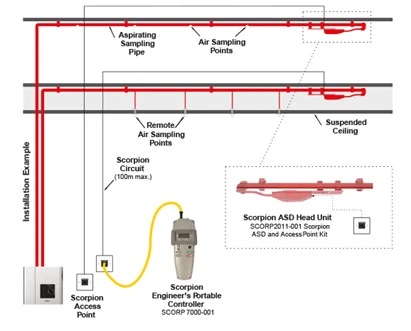
How iCAM ASD Works: The installer drills one or more small holes (typically up to 2 mm) in the sampling pipe along critical areas of the ceiling. The iCAM aspirator then pulls air through these holes into its detection chamber. Because it actively samples, iCAM catches smoke even in high-ceiling or high-airflow spaces where smoke might otherwise disperse. Inside, the sensor (for example, a photoelectric detector) measures obscuration: even tiny smoke (in parts-per-million) causes a measurable signal. If the smoke level exceeds a set threshold, the iCAM module switches from Pre-Alarm to Fire-Alarm mode. Crucially, these thresholds and alarm delays are fully programmable. Managers can set a very sensitive pre-alarm stage (alerting building staff early) and then a higher threshold for an evacuation alarm. This tiered approach aligns with modern fire codes and gives extra reaction time. The iCAM also reports faults or slow airflow (if filters clog) via its status outputs, which can be monitored on the fire alarm panel.
Benefits of iCAM Aspirating Detection
- Extra-Early Warning: iCAM senses the smallest traces of combustion. It can often detect a fire before smoke would reach ceiling-mounted alarms. In tests, aspirating detectors typically alert up to 5–10× sooner than point detectors. This head start can mean evacuating a building and deploying sprinklers before a fire spreads.
- Large Coverage: A single iCAM unit can protect a large volume via its pipe network. For instance, one IAS-2 with two inlets and dual sensors might cover an entire warehouse aisle of over 200 m², where dozens of spot detectors would otherwise be needed. This efficiency cuts hardware and wiring costs for big spaces.
- Robust in Challenging Areas: Since iCAM actively samples, it works well in difficult environments. High-ceiling lobbies, server rooms with strong HVAC flows, noisy industrial plants – in all these, passive smoke detectors struggle, but iCAM’s piped detection will still pick up smoke. It also operates reliably in sub-zero freezers or dusty spaces if maintained properly (using its filters).
- Flexible and Safe: The iCAM module is essentially fire-rated and tamper-proof, and its IP65 enclosure lets you install it in basements or near dust sources. With multiple alarm levels and resettable filters, false alarms are minimized. Facilities can also program iCAM to interface with the building management system, giving centralized monitoring.
- Compliance & Integration: iCAM meets key fire-safety standards. EN54-20 (European ASD standard) lists it for Class C sensitivity. It is UL/ULC Listed and FM Approved for use with standard fire control panels. With a standard output protocol (Gent addressable loop or analog output), it integrates seamlessly. Many customers appreciate that iCAM can reuse existing point detector wiring: it “talks” to the fire panel just like a normal detector, making retrofits easier.
Voice Search Question: “Is aspirating smoke detection better than regular detectors?” In general, yes for high-risk or large spaces. Aspirating detectors like iCAM are designed for early-warning in places where time is critical – for example, detecting overheated equipment, arcing, or smoldering in hidden voids. They are used when the goal is “detect smoke before smoke”. In typical offices or homes, ordinary smoke alarms suffice; but for data centers, elevators, heritage sites or medical gas rooms, iCAM’s extra vigilance is invaluable.
iCAM vs. Other ASD Solutions
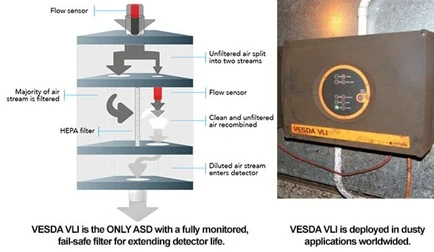
Compared to premium laser-based ASDs (like VESDA), iCAM takes a more conventional approach. It houses standard point smoke sensors inside a sampling unit, instead of using a custom sensing chamber. This makes iCAM cost-competitive for smaller applications (single-room or point-in-a-box uses). On the other hand, VESDA systems (by same parent company Xtralis) offer multi-zone coverage with digital signal networking – more suited to very large installations. The advantage of iCAM is its simplicity and modularity. You can install multiple iCAM units each serving a small area, with each being self-contained. No need for a central ASP controller. This is great for phased installations or buildings with many fire zones.
Applications & Case Examples
Where is iCAM used? The datasheet and product literature list many applications: elevator shafts, prisons or police custody suites (tamper-proof rooms), communication closets, underfloor spaces, and even museums. In essence, anywhere a discreet yet sensitive detector is needed. For instance, a major hospital in Europe chose iCAM units for its MRI suite ceilings, since conventional detectors can’t be placed near strong magnets. Another example: a data center used iCAM to cover cable trays in a raised floor (sampling through small holes) and caught a malfunctioning UPS fan smoke long before the batteries overheated.
While specific published case studies on iCAM are limited, the general success of ASD is well documented. For example, in cold-storage facilities (ice tunnels at −30°C), companies like Conestoga Cold Storage rely on WAGNER TITANUS ASD to detect fires early, illustrating ASD’s value even in extreme conditions. iCAM’s point-in-box format makes it the natural ASD choice for single-room protections.
Standards & Compliance
iCAM detectors comply with global fire codes. It is listed to EN54-20 (for aspirating detectors), meaning it has certified sensitivity settings. It also carries FM/UL approval, ensuring it meets UL 268 smoke detector performance requirements in North America. In India and many regions, no special code forbids ASD; these units simply meet the general standard for smoke detectors. (Notably, some standards like NFPA 72 discuss ASD, and NFPA 75/76 set stricter “very early” criteria for electronic sites. iCAM configurations can be tuned to meet these as needed.) As always, any installation should be designed by trained fire-safety professionals.
FAQs
- What’s the difference between IAS and ILS models? The iCAM IAS-1/2 are Point-In-A-Box units (housing conventional sensors inside). The ILS series (ICAM ILS Point-in-a-Box) is similar but specifically for addressable loops (see Xtralis ILS datasheet). Both serve the same general function of single-point sampling.
- How far can an iCAM sample? Each iCAM inlet can handle up to about 70–100 meters of pipe length (depending on model). In practice, you’d use 2″ or 3″ pipe with holes spaced per code (roughly one hole per 30ft of coverage). Note that sampling distance isn’t infinite: beyond specs, smoke may not travel effectively.
- Can iCAM replace ordinary smoke detectors? Yes, in suitable zones. For example, instead of running multiple spot detectors in a duct or shaft, you could install one iCAM with pipe holes in that area. It essentially performs the same function – alerting the fire panel – but with enhanced sensitivity and flexibility. However, for normal open-air rooms with low ceilings, point detectors may still be sufficient and simpler.
- Does it need special maintenance? iCAM has a reusable filter that should be checked annually (clean or replace as needed). The aspirator fan is durable, but airflow should be tested regularly (the device itself reports “flow fault” if pipes are blocked). Maintenance is well-documented by the manufacturer. Overall, upkeep is similar to other fire detectors, with the added filter cleaning step.
Conclusion & Next Steps
iCAM aspirating smoke detectors provide an important safety upgrade for critical environments. By sampling air and using high-sensitivity sensing, they give far earlier warnings than conventional alarms in challenging spaces. For building owners and engineers, they are a smart choice when every second counts.
If you’re considering aspirating smoke detection, consult with a qualified fire-safety integrator. Companies like Cyber Info Electronics Security System offer design and installation services for iCAM systems and other ASDs. We can assess your needs, configure the right iCAM model, and ensure it ties into your fire alarm panel or BMS. Early fire detection saves lives and assets – reach out for a consultation to see how iCAM can enhance your safety.
Sources: Information above is drawn from official iCAM datasheets and fire-protection publications. We’ve also referenced global standards (EN54-20) and expert insights on ASD technology to ensure accuracy. The features and applications of iCAM are confirmed by manufacturer literature.