

Automatic Boom Barrier Systems: The Growing Need for Smarter Vehicle Access Management
August 18, 2026
Gate Automation Solutions Building Smarter Safer and More Efficient Entrances
August 30, 2026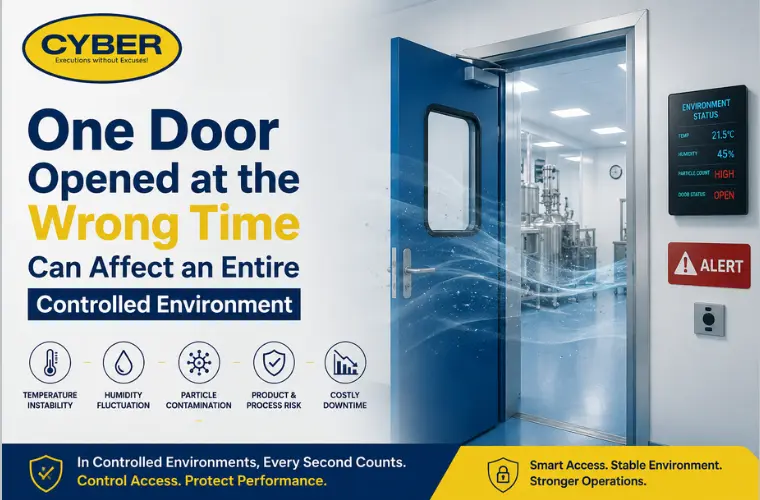
Table of Contents
- Why Controlled Access Is Important
- What Is a Door Interlocking System
- How Door Interlocking Systems Work
- Where Door Interlocking Systems Are Used
- Benefits of Door Interlocking Systems
- Integration with Building Security Systems
- Choosing the Right Door Interlocking Solution
- Conclusion
- FAQs
Door Interlocking Systems Why Controlled Access Matters in Critical Environments
Not every door inside a building serves the same purpose. In many industries, a door is more than an entry or exit point. It acts as a controlled access point that supports security, operational discipline, and regulated movement between different areas.
Facilities such as pharmaceutical manufacturing units, hospitals, laboratories, cleanrooms, biotechnology centres, food processing plants, semiconductor facilities, and industrial environments often require controlled movement between adjoining spaces. If two connected doors are opened simultaneously, unwanted airflow between rooms may occur, increasing the possibility of contamination, affecting operational procedures, or creating safety concerns.
A Door Interlocking System helps prevent simultaneous opening of interconnected doors by allowing only one door within an interlocked group to remain open at a time. It is important to understand that the interlocking system itself does not maintain room pressure. Pressure differentials are created and maintained by the HVAC system. Door interlocking simply helps preserve those controlled conditions by preventing multiple connected doors from being opened simultaneously.
Instead of relying entirely on manual procedures, organizations can use automated interlocking to achieve more consistent access management throughout the facility.
Why Controlled Access Is Important
Modern facilities are becoming increasingly automated while also placing greater emphasis on environmental control, product quality, and operational safety.
For example, pharmaceutical cleanrooms depend on controlled air pressure to reduce contamination risks. Hospitals separate sterile and isolation areas to protect patients, while laboratories often require controlled movement between research environments.
In these facilities, HVAC systems maintain the required pressure differentials between adjacent rooms. However, if multiple interconnected doors remain open at the same time, the intended airflow pattern may be disrupted.
A Door Interlocking System helps reduce this possibility by ensuring that only one interconnected door can remain open during movement between controlled areas.
This coordinated sequence supports operational discipline while helping preserve the environmental conditions established by the HVAC system.
What Is a Door Interlocking System
A Door Interlocking System is an electronic access control solution that manages the relationship between two or more interconnected doors.
Rather than allowing every door to operate independently, the system prevents simultaneous opening by temporarily locking the remaining doors whenever one door is opened.
Once the first door has been completely closed, the next authorized door can be unlocked.
Unlike a conventional door lock that secures a single entrance, an Interlocking Door System coordinates movement between connected spaces to support controlled access procedures.
Depending on the operational requirement, the system may integrate with RFID readers, biometric authentication, keypad access, emergency controls, centralized monitoring platforms, or access control software.
How Door Interlocking Systems Work
Although system designs vary depending on the application, the operating principle remains consistent.
Each interconnected door continuously communicates with the interlock controller.
When an authorized user opens one door, the controller temporarily prevents the remaining interconnected doors from opening.
Only after the first door has fully closed does the controller release the next door for authorized access.
Because this sequence is automated, the possibility of accidental simultaneous door opening is significantly reduced.
The result is a more structured movement process that supports operational consistency while reducing dependence on manual supervision.
Where Door Interlocking Systems Are Used
Door interlocking systems are commonly installed wherever controlled movement between adjacent areas is required.
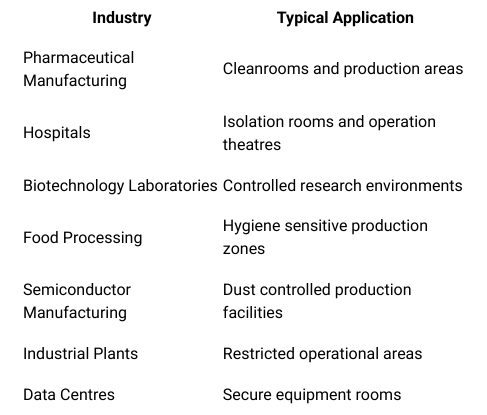
Although operational objectives vary across industries, each environment benefits from preventing simultaneous door opening between connected spaces.
Benefits of Door Interlocking Systems
The primary purpose of a Door Interlocking System is to regulate movement in a controlled and predictable manner.
By preventing interconnected doors from opening simultaneously, organizations can support established operational procedures while helping preserve environmental conditions maintained by HVAC systems.
The system also promotes consistency by applying the same controlled access sequence every time a user moves between protected areas.
Because the interlocking sequence is automated, organizations reduce dependence on manual coordination while encouraging standardized movement practices throughout the facility.
Another important advantage is integration. Rather than operating independently, the Door Interlock Solution can become part of a broader access management infrastructure, allowing access events to be monitored through centralized security platforms.
In facilities where cleanliness, process integrity, or restricted access is important, this coordinated approach contributes to more reliable daily operations.
Integration with Building Security Systems
Modern facilities rely on multiple building technologies working together rather than operating as isolated systems. A Door Interlocking System is therefore commonly integrated with access control systems, CCTV surveillance, Building Management Systems, visitor management platforms, centralized monitoring software, and fire alarm systems.
Access control systems determine who is authorized to enter an interlocked area through RFID cards, biometric readers, PIN credentials, or other authentication methods. Once authorization is verified, the interlocking controller manages the sequence of door operation.
CCTV systems simultaneously record access events, while centralized monitoring platforms provide operators with real time visibility of door status, alarms, and access activity.
In cleanroom environments, the Building Management System and HVAC infrastructure maintain the required room pressure and environmental conditions. The Door Interlocking System complements these systems by preventing simultaneous opening of interconnected doors, helping preserve the pressure differential established by the
HVAC system. It is important to note that the interlocking system itself does not generate or regulate room pressure.
Fire alarm integration requires careful engineering and should never follow a single standard behavior for every facility. During an emergency, door operation depends on the approved fire cause and effect matrix, the configured fail safe or fail secure logic, and the applicable egress requirements for the building.
Depending on the approved fire strategy, some interlocked doors may automatically release to support occupant evacuation, while others may continue operating according to the approved emergency sequence. The final behavior is determined during system design in accordance with the project’s life safety requirements and applicable regulations.
Organizations planning new facilities or upgrading existing infrastructure often evaluate door interlocking as one part of a broader building automation and security strategy rather than an isolated access control device.
Cybergroup integrates Door Interlocking Systems with access control, CCTV surveillance, Building Management Systems, fire alarm infrastructure, and centralized monitoring platforms to create coordinated solutions that align with each facility’s operational and life safety requirements.
Choosing the Right Door Interlocking Solution
Selecting a Door Interlocking System involves much more than choosing electronic locks.
Organizations should first evaluate how people move between controlled areas, the number of doors requiring interlocking, emergency evacuation requirements, environmental conditions, and the level of access control required.
For cleanrooms and pharmaceutical facilities, the interlocking sequence should be planned alongside the HVAC design so that both systems complement each other. While HVAC maintains the pressure cascade, the interlocking system helps reduce pressure disturbances by preventing multiple connected doors from opening simultaneously.
Healthcare facilities may require emergency override functions based on approved life safety requirements, while industrial plants may prioritize restricted movement into hazardous process areas.
Integration requirements should also be evaluated during planning. Many organizations combine door interlocking with biometric authentication, visitor management, centralized monitoring, CCTV surveillance, and Building Management Systems to create a unified access management platform.
Future expansion is another important consideration. As facilities grow, additional interlocked doors, controlled zones, or security systems may need to be incorporated into the existing infrastructure.
Careful planning helps ensure that the selected Door Interlock Solution supports both current operational requirements and future facility development.
Conclusion
Controlled environments depend on controlled movement, clearly defined operational procedures, and properly coordinated building systems.
A Door Interlocking System supports these objectives by preventing simultaneous opening of interconnected doors, improving controlled access, and encouraging consistent movement between sensitive areas.
Rather than maintaining room pressure directly, the system works alongside HVAC infrastructure by helping preserve the controlled airflow conditions established within the facility.
When integrated with access control, CCTV surveillance, Building Management Systems, centralized monitoring platforms, and appropriately engineered fire alarm interfaces, Door Interlocking Systems become an important component of modern building security and operational management.
Whether implemented in pharmaceutical manufacturing, hospitals, laboratories, semiconductor facilities, industrial plants, or data centres, these systems contribute to safer, more organized, and better controlled environments.
FAQs
What is a Door Interlocking System?
It prevents interconnected doors from opening simultaneously to support controlled access.
Does a Door Interlocking System maintain cleanroom pressure?
No. HVAC maintains room pressure. Door interlocking helps preserve it by preventing simultaneous door opening.
Can Door Interlocking Systems integrate with access control?
Yes. They commonly integrate with RFID, biometrics, keypad authentication, and centralized access management.
How do Door Interlocking Systems behave during a fire alarm?
Door behavior depends on the approved fire cause and effect matrix, fail safe or fail secure logic, and egress requirements.
Can Door Interlocking Systems integrate with CCTV and Building Management Systems?
Yes. They commonly integrate with CCTV surveillance, Building Management Systems, visitor management platforms, and centralized monitoring software.