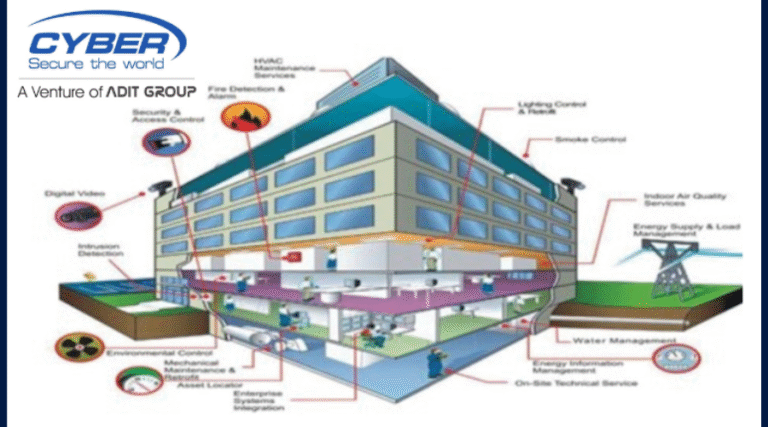

A building management system (BMS) monitors and controls a building’s services from one screen: HVAC, lighting, energy, pumps, lifts, fire and security. A well-designed BMS system cuts energy waste, finds faults early and lets a small facility team run a large building.
Cyber Group designs, supplies, installs, programs and maintains BMS and IBMS (integrated building management system) solutions for commercial buildings, hospitals, hotels, factories and campuses across India. Because we also deliver fire alarm, CCTV, access control, PA and structured cabling, we connect them all to one platform.
What Our BMS System Controls
- HVAC: chillers, AHUs, FCUs, cooling towers, pumps and ventilation fans, with temperature, humidity and CO2-based control.
- Lighting: schedules, zones and occupancy-based control, including DALI lighting control.
- Energy: energy meters, DG sets, transformers and UPS systems, with consumption reports.
- Water: tank levels, pumps and water leakage detection.
- Lifts and utilities: status and fault alarms.
- Fire and life safety: fire alarm status, fire pump status and smoke management interlocks.
- Security: alarms and events from CCTV and access control on the same screen.
BMS or IBMS?
| BMS | IBMS | |
|---|---|---|
| What it covers | HVAC, lighting, energy, water and utilities | Everything in a BMS, plus fire alarm, CCTV, access control and PA |
| Control room view | Building services | Building services, safety and security on one platform |
| Best for | Buildings that mainly need energy and comfort control | Hospitals, hotels, IT parks, campuses and large public buildings |
Not sure which one fits? Our team recommends the right setup after a site survey.
How a Building Management System Works
- Field level: sensors for temperature, humidity, pressure, CO2 and flow, and actuators for valves and dampers, installed on the equipment.
- Control level: DDC (direct digital control) controllers in panels near the equipment read the sensors and run the control logic.
- Management level: the BMS server and software show live graphics, alarms, trends, schedules and reports to the facility team.
- Open protocols: BACnet and Modbus connect chillers, VFDs, energy meters, DG sets and lifts from different makers.
- Wireless options: wireless BMS devices suit existing buildings where running new cables is difficult.
Benefits of a BMS System
- Lower energy use: equipment runs only when needed, at the right setpoint.
- Faster fault response: alarms reach the facility team at once, often before occupants notice.
- Better comfort and air quality: stable temperature, humidity and fresh air.
- Data for decisions: trends and reports show where energy goes and which equipment needs attention.
- Smaller facility teams: one control room runs the whole building or campus.
- Records for audits: useful for green-building ratings and environmental monitoring in pharma and hospitals.
Our Scope: Design to AMC
- Site survey and point schedule: we list every input and output to monitor and control, with your MEP consultant.
- Design: controllers, network, control logic and graphics.
- Supply: certified products, compliant with RoHS, UL, CE, FCC and LPCB.
- Installation, programming, testing and commissioning: point-to-point checks, logic tests and graphics sign-off.
- Integration: BACnet and Modbus links to chillers, VFDs, DG sets, meters and lifts, plus the fire alarm, CCTV and access control for a full IBMS.
- Training and AMC: operator training, software updates, sensor calibration and 24×7 service support.
Where We Install BMS
Commercial towers and IT parks · Hospitals · Hotels · Pharma plants and cleanrooms · Data centres · Factories and industrial campuses · Malls · Residential towers · Educational campuses
Why Cyber Group
- 25+ years of experience in ELV, fire and security systems
- 3,000+ projects delivered across India
- ISO 9001:2015 certified company
- One team for BMS, fire, security and communication systems
- AMC and 24×7 service support
BMS System: FAQs
A building management system (BMS) is a computer-based control system that monitors and controls HVAC, lighting, energy, pumps, lifts and other building services from one screen, with alarms, schedules and reports.
A BMS mainly controls building services such as HVAC, lighting and energy. An IBMS (integrated building management system) also brings the fire alarm, CCTV, access control and PA onto the same platform.
Yes. Controllers and sensors can be retrofitted, existing equipment can be connected over BACnet or Modbus or through interface modules, and wireless BMS options reduce the need for new cabling.
A well-configured BMS reduces waste by running equipment on schedules and setpoints that match real need. The savings depend on the building, the equipment and how well the system is used and maintained.
At the MEP design stage, so equipment is ordered with the right interfaces, and controllers, panels and cabling are included in the drawings.
Yes. Our head office is in Ahmedabad and we deliver projects across India.
Planning a BMS or IBMS for Your Building?
Talk to our team for a site survey, point schedule and quote.
Your Queries, Our Priority – Contact Now!